Action Guide · Updated April 2026 · 8 min read
How to Stop Bleeding Gums — The 4-Step Evidence-Based Protocol
Bleeding gums are the #1 warning sign of gingivitis — reversible gum disease. Caught and treated now, your gums stop bleeding in 10-14 days. Ignored, 10-15% of cases progress to irreversible periodontitis. This guide covers the 4-step protocol that reverses the vast majority of cases, plus the critical warning signs that mean "see a dentist this week."

Disclosure: We may earn a commission when you purchase through our links, at no extra cost to you. Our recommendations are based on independent testing and research. Full disclosure.
The short answer
Bleeding gums = gingivitis in 95%+ of cases. The 4-step fix: (1) electric toothbrush + fluoride paste 2×/day, (2) floss or water-floss every tooth daily (water flossers reduce bleeding 29-93% more), (3) antimicrobial rinse (chlorhexidine short-term or OTC CPC), (4) oral probiotic with L. reuteri (RCT-backed for reducing bleeding on probing). Most cases stop bleeding in 10-14 days. Do NOT stop flossing even if bleeding temporarily increases — this is normal days 1-3, then decreases.
- 🩸 Cause in 95%+ of cases: gingivitis (reversible)
- ⏱ Timeline: 10-14 days mild, 2-4 weeks moderate
- 🧪 Most effective probiotic: ProDentim (3 strains + L. reuteri)
- ⚠️ See dentist if: persists 4+ weeks despite protocol
Our top pick for bleeding gums
ProDentim contains Lactobacillus reuteri, the probiotic strain with the strongest clinical evidence for reducing gum bleeding. A 2020 systematic review of 14 RCTs confirmed significantly reduced bleeding on probing vs placebo. Pairs with the mechanical 4-step protocol to accelerate healing.
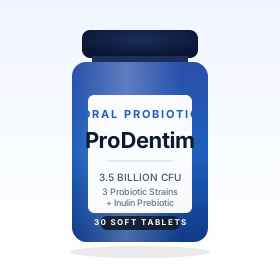
ProDentim
ProDentim
Pros
- L. reuteri — strongest evidence for bleeding reduction
- 3.5 billion CFU across 3 strains
- Inulin prebiotic support
- Chewable format for oral colonization
- 60-day money-back guarantee
- 95,000+ user reviews
Cons
- Official site only
- Higher price than basic probiotics
- 4-8 weeks for full effect
Why your gums bleed — the bacterial mechanism
Healthy gums do not bleed during normal brushing or flossing. The fact that yours do signals inflammation — caused in 95%+ of cases by bacterial plaque accumulating along the gum line. Bacteria produce acids and toxins that trigger your immune response. Inflammatory mediators make blood vessels in the gum tissue fragile and dilated. Normal mechanical pressure from brushing then ruptures these vessels.
This is fixable. Remove the plaque → inflammation subsides → vessels stabilize → bleeding stops. The 4-step protocol below accomplishes this systematically.
The 4-step evidence-based protocol
4-step protocol to stop bleeding gums
| Ingredient | Dose | Role | Evidence |
|---|---|---|---|
| Step 1: Electric toothbrush + fluoride | 2 min, 2× daily | Oral-B iO or Sonicare with pressure sensor. 21% more plaque removal vs manual. | Cochrane |
| Step 2: Daily flossing or water flossing | Every tooth, 1× daily | Water flossers reduce bleeding 29-93% more than string floss | Multiple RCTs |
| Step 3: Antimicrobial rinse | 2× daily, 10-14 days | Prescription chlorhexidine 0.12% (gold standard) or OTC cetylpyridinium chloride (Crest Pro-Health) | Cochrane |
| Step 4: Oral probiotic (L. reuteri) | 1× daily, minimum 4 weeks | Reduces gingival inflammation and bleeding on probing. RCT-backed. | Systematic review |
| Supporting: Salt water rinse | 3× daily | ADA-recommended adjunct. Reduces swelling. | Established |
| Supporting: Vitamin C adequate | 500-1000 mg daily | Only if dietary intake low. Not a replacement for hygiene. | Established for deficiency |
The counterintuitive truth: bleeding INCREASES before it decreases
Most people stop flossing when their gums bleed more, assuming they're "making it worse." They're backwards. When inflamed tissue is physically disrupted by floss, bleeding temporarily increases for 3-5 days — then decreases steadily as the inflammation resolves.
Expected timeline:
- Days 1-3: bleeding may INCREASE as tissue is disrupted and plaque removed
- Days 4-7: bleeding plateaus or begins to decrease
- Days 7-14: bleeding markedly decreases in mild cases
- Days 14-28: bleeding resolved in moderate cases
- Beyond 4 weeks: persistent bleeding → see a dentist
Critical rule: do NOT stop flossing during the initial bleeding increase. Persistent daily flossing is what eliminates the plaque and allows the tissue to heal.
When to escalate to a dentist
- Bleeding persists >4 weeks despite proper protocol
- Gums bleed spontaneously (without brushing/flossing)
- Pus or discharge from gums
- Fever, facial swelling, severe pain
- Loose teeth in the bleeding area
- Unusual bruising or bleeding elsewhere (possible clotting disorder)
- You are pregnant (pregnancy gingivitis needs management)
Preventing recurrence long-term
- Electric toothbrush 2×/day permanently
- Daily flossing or water flossing permanently
- Oral probiotic daily (ProDentim or equivalent)
- Professional cleaning every 6 months
- Quit smoking/vaping (nicotine masks bleeding while worsening disease)
- Blood sugar control if diabetic
- Daily CoQ10 (100-200 mg) + omega-3 (1-2 g) as systemic anti-inflammatory
FAQ
How do I stop my gums from bleeding immediately?
Immediate stop: rinse with warm salt water (½ tsp in 8oz water) for 30 seconds, apply cold compress to cheek, avoid aggressive brushing that area for 24h. Continue gentle brushing elsewhere. Bleeding from brushing reflects inflammation — stopping temporarily does not fix the underlying gingivitis. For permanent resolution, follow the 4-step protocol (brush, floss, antimicrobial, probiotic) for 10-14 days.
Why do my gums bleed when I brush my teeth?
In 95%+ of cases: gingivitis (early gum disease). Bacterial plaque along the gum line triggers inflammation that makes blood vessels in the gum tissue fragile. Less common causes: aggressive brushing technique, vitamin C/K deficiency, blood-thinning medications, pregnancy hormonal changes, or (rarely) clotting disorders/leukemia. Healthy gums do NOT bleed during normal brushing — it is always a warning sign.
How long does it take for bleeding gums to heal?
With proper protocol: mild cases stop bleeding in 5-10 days, moderate in 10-14 days, more severe in 2-4 weeks. Counterintuitive pattern: bleeding often INCREASES days 1-3 as inflamed tissue is disrupted, then decreases steadily from day 5. Persevere through the initial increase. If bleeding persists beyond 4 weeks despite proper hygiene, see a dentist.
Does vitamin C stop bleeding gums?
Only if vitamin C deficiency is the cause (rare in developed countries). Vitamin C is essential for collagen synthesis in gum tissue, and severe deficiency (scurvy) causes dramatic bleeding. However, the vast majority of bleeding gums are caused by bacterial plaque — vitamin C supplementation does not fix gingivitis. Routine C intake (500-1000mg) is only helpful alongside proper oral hygiene.
What is the best product for bleeding gums?
For mechanical cleaning: electric toothbrush with pressure sensor (Oral-B iO, Philips Sonicare) + water flosser. For bacterial reduction: prescription chlorhexidine mouthwash 0.12% (10-14 days only) or OTC cetylpyridinium chloride. For microbiome rebalancing: oral probiotic with L. reuteri (strongest RCT evidence for reducing bleeding on probing). Best all-in-one pick: ProDentim combines L. reuteri with prebiotic support.
Stop bleeding gums faster with evidence-based probiotics
ProDentim's L. reuteri has the strongest RCT data for reducing bleeding on probing. Complements the 4-step protocol for faster recovery.
Check ProDentim pricing →